
Field Notes
Does Rain Actually Clean Solar Panels in Portland?
· 6 min read · solar cleaning, rain, pollen, portland
Rain rinses loose dust off Portland-area solar panels, but it leaves bonded pollen, bird droppings, road film, and mineral haze behind. Here is what rain really removes, what it misses, and what that costs you in energy production.
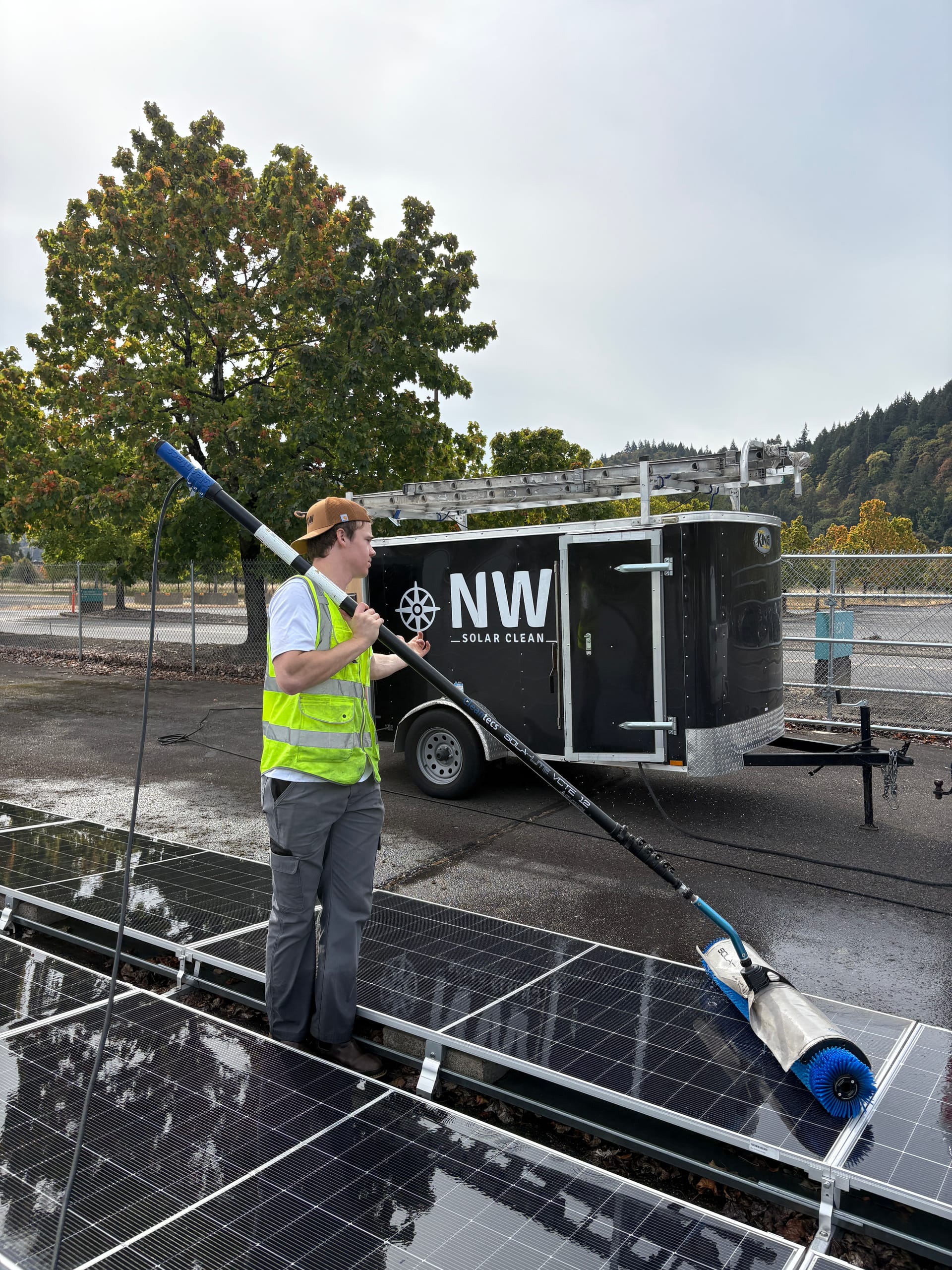
Owen gets this question a lot, usually from someone standing in their driveway after a storm, squinting up at their roof and wondering if they just saved themselves a chore. It's a fair question. We get plenty of rain here in Sherwood and across the greater Portland metro, so it seems reasonable to assume the sky is doing the cleaning for free. The honest answer is that rain helps, but it's not doing the job you think it is.
What Rain Actually Removes
Rain is good at rinsing away loose, dry dust. If a light film of road dust or cottonwood fluff has settled on your panels overnight, a decent rain can knock a lot of that down and carry it off the edge of the glass. That's genuinely useful, and it's one reason panels in rainy climates don't get as grimy as panels in a place like Phoenix or Bakersfield.
But loose dust was never the biggest problem. The stuff that actually cuts into your energy production is the stuff rain doesn't touch.
What Rain Leaves Behind
Pollen is the big one around here. Late spring brings a wave of fir, alder, and grass pollen that doesn't just sit on top of the panel, it bonds to the glass with a slightly sticky residue. Rain beads up and rolls right over it instead of lifting it off. Add in bird droppings, which are acidic and can etch into the glass coating if left too long, plus the fine diesel and brake-dust film that collects near highways like I-5 and 99W, and you've got a layer that water alone just reorganizes rather than removes.
There's also the mineral problem. Portland tap water and rainwater both carry dissolved minerals, and when a light rain evaporates off a warm panel, it leaves behind faint water spots and a hazy film. Enough of those cycles and you get a panel that looks "rained on" but is actually dirtier in a diffuse, hard-to-see way. That haze scatters sunlight instead of letting it hit the cells directly, which quietly chips away at your system's output.
Why This Matters for Energy Production
Solar panels work by letting sunlight hit the photovoltaic cells underneath the glass. Anything sitting on that glass, even a thin layer, blocks or scatters some of that light. A panel that looks "pretty clean" to the eye can still be running at a noticeable deficit because of buildup rain never cleared. Multiply that across a whole roof's worth of panels, or across a commercial array with hundreds of modules, and the lost production adds up over a year.
This is especially true in our region's long gray stretch from fall through spring, when every bit of sunlight matters more because there's less of it to begin with. A dusty or pollen-coated panel during a rare sunny February afternoon is wasting exactly the production you need most.
A Pattern We See Every Spring
Every year around late April, we get a run of calls from homeowners who say the same thing: their panels looked fine all winter, then suddenly there's a yellow-green dusting that just won't rinse off no matter how hard it storms. That's tree pollen season hitting its peak, and it's almost always the busiest stretch on our schedule. By the time most people call, the pollen has had a few warm, dry days to bake onto the glass, which is exactly why the spring rains alone never seem to fix it.
What Actually Gets Panels Clean
The fix isn't more water, it's the right kind of water applied the right way. Our residential cleaning service uses soft brushes and de-ionized water, which doesn't leave mineral spots behind the way regular tap water or rain does. That means panels come out streak-free, not just rinsed. For businesses and larger installations, our commercial cleaning crews handle rooftop, ground-mount, and tracker arrays up to 2,700 panels, with before-and-after photos and a full report so facility managers have documentation, not just a clean roof.
Every cleaning we do also includes a visual inspection, since we're already up there looking closely at every panel. That's part of our inspection and maintenance approach, and it's how small issues like loose connectors or cracked glass get caught before they become expensive problems. If your array sits near trees, a busy road, or anywhere with heavy pollen, our semiannual plan under that same page is usually the better fit, since one cleaning a year isn't always enough to outpace two pollen seasons and a wet winter in between.
While we're on a roof or working the exterior of a house, a lot of customers ask if we also do windows. We do, using that same de-ionized water system, which means no hard-water streaks and no chemical residue on the glass either. It's a natural add-on to a solar cleaning visit if your windows have been collecting the same grime as your panels.
Working With Other Local Pros
We stay in our lane, which is panels and glass, but we work alongside other local businesses that handle the rest of a property. If you're also freshening up your outdoor living space for the season, ask about The Back Patio (thebackpatio.info), who we work with regularly for patio and outdoor furniture care around the Portland area. It's a natural pairing since spring cleanup usually means more than just the roof.
So, Is Rain Enough?
Rain is a helpful assist, not a cleaning plan. It'll knock down loose dust between visits, but it won't touch bonded pollen, bird droppings, road film, or the mineral haze that builds up over months of wet weather. If you're relying on Oregon's rainy reputation to keep your system clean, you're probably leaving production on the table without realizing it.
The simplest way to know for sure is to get a free written quote and let someone take a close look at your actual panels, not a general assumption about what rain does. Sherwood and the surrounding Portland metro get enough rain to make people complacent about panel care, and that complacency is usually what costs homeowners the most kilowatt-hours over a year.
FAQ
Does rain clean solar panels enough on its own?
Rain removes loose dust and light debris but leaves behind pollen, bird droppings, road grime, and mineral residue. Most systems in the Portland area still need a proper cleaning at least once a year to stay efficient.
How much energy production is lost to dirty panels?
It varies by site, but buildup from pollen season and road film can meaningfully reduce output, especially during the shorter daylight months. A visual inspection during a cleaning is the best way to see how much your specific array is affected.
When is the worst time of year for panel buildup in Oregon?
Late spring, during peak tree and grass pollen season, is typically the worst stretch, since pollen bonds to the glass faster than rain can rinse it away. Properties near trees or busy roads often need a second cleaning in fall to catch road film and falling debris.
Can regular tap water be used instead of de-ionized water?
Tap water contains minerals that leave spots and haze behind as it dries, which is part of why rain alone doesn't leave panels truly clean. De-ionized water dries without residue, which is why it's used for both panel and window cleaning.